

IVF Success Rates by Age: What Do the Numbers Really Mean?
When researching fertility treatment, many patients immediately look up IVF success rates by age. The numbers can be useful, but they are easy to misunderstand. Age is one of the strongest predictors of IVF outcomes when a patient is using their own eggs, yet it is only one part of the picture. Ovarian reserve, diagnosis, embryo development, prior treatment history and other individual factors can all affect the likelihood of success.
Just as important, not every “IVF success rate” measures the same outcome. A pregnancy rate, a live birth rate per embryo transfer and a cumulative live birth rate after an egg retrieval are different statistics. Understanding what a number actually represents can make IVF success rates much more useful.
How Does Age Affect IVF?
Age affects fertility largely through changes in both egg quantity and egg quality. The number of remaining eggs declines over time, and the likelihood of chromosomal abnormalities in eggs increases with age. As a result, it may become more difficult to create an embryo capable of developing into a healthy pregnancy.
Age can also influence how the ovaries respond to IVF stimulation. Tests such as anti-Mullerian hormone (AMH), follicle-stimulating hormone (FSH) and antral follicle count (AFC) help fertility specialists estimate ovarian reserve and anticipate how a patient may respond to medication. These tests provide useful information, but they do not replace age or predict pregnancy with certainty.
IVF can help overcome many causes of infertility, but it cannot completely reverse the biological effects of ovarian aging. That is one reason fertility specialists often encourage patients who are concerned about fertility to seek an evaluation rather than relying on age-based statistics alone.
What Does “IVF Success Rate” Actually Mean?
The most meaningful endpoint for many patients is live birth. But success can be reported in several ways, and the denominator matters.
- Clinical pregnancy rate: the percentage of cycles or transfers that result in a pregnancy confirmed clinically, often by ultrasound.
- Implantation rate: a measure of implantation relative to embryos transferred.
- Live birth rate per embryo transfer: the percentage of embryo transfers that result in a live birth.
- Live birth rate per egg retrieval or intended retrieval: the percentage of retrieval attempts that ultimately result in a live birth.
- Cumulative live birth rate: a measure that can include more than one embryo transfer resulting from the same egg retrieval over a defined follow-up period.
These numbers are not interchangeable. A rate calculated only among patients who reached embryo transfer will usually answer a different question than a rate calculated from the beginning of an egg-retrieval attempt. When comparing statistics, first ask exactly what outcome is being measured.
What Do National IVF Success Rates Look Like by Age?
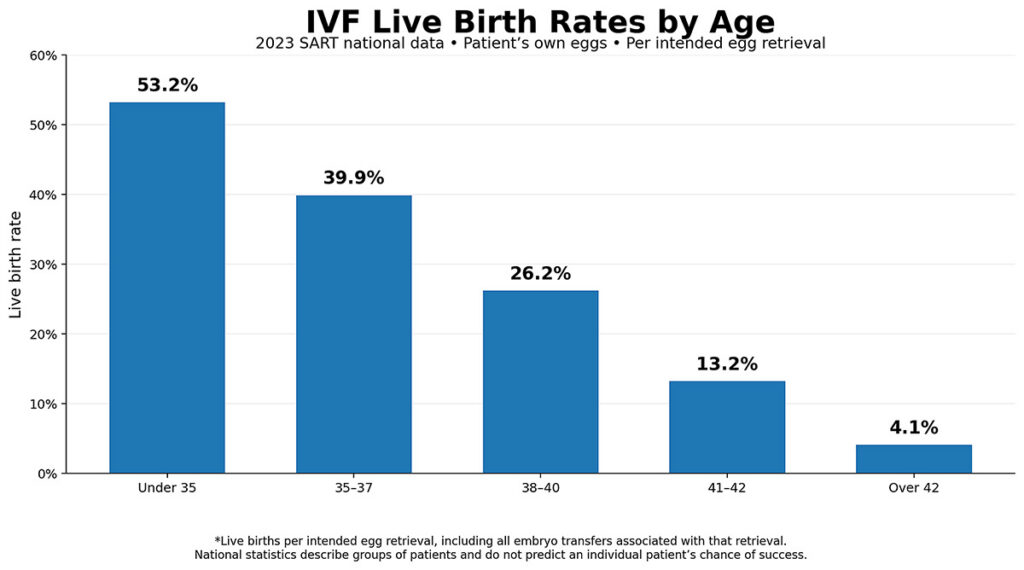
National data show the same broad pattern patients often hear about in the clinic: live birth rates using a patient’s own eggs generally decline as age increases. The chart below uses the 2023 final national summary from the Society for Assisted Reproductive Technology (SART). It reports live births per intended egg retrieval, including all embryo transfers associated with that retrieval.
Why These Numbers May Look Different From Other IVF Statistics
You may find different percentages on another website and both sets of numbers may be accurate. One source may report live birth per first embryo transfer, while another reports cumulative live birth after an egg retrieval. Some statistics describe all patients, while others are limited to patients with no previous ART treatment. The age groups may also differ.
For example, the same 2023 SART national report shows lower live birth rates when it looks only at the first embryo transfer associated with an intended retrieval. That does not mean the data conflict. It means the statistics are answering different questions.
What Do IVF Success Rates Tell Me About My Own Chances?
Age-based IVF success rates are best viewed as a starting point, not a personal forecast. Two patients of the same age can have very different fertility histories, ovarian reserve, diagnoses, numbers of eggs retrieved and embryo outcomes.
The CDC specifically cautions against treating clinic success rates as an individual patient’s chance of success. Clinics may also treat different patient populations and use different treatment approaches, so comparing one clinic’s percentage directly with another clinic’s percentage can be misleading.
A fertility specialist can put national or clinic-level statistics into context using information from your evaluation and treatment history. The goal is not simply to find the percentage associated with your age. It is to understand which factors are most relevant to you.
What About IVF Success After Age 40?
IVF can still result in live birth after age 40, but national data show a steeper decline in success using a patient’s own eggs. In the 2023 SART national summary, the cumulative live birth rate per intended egg retrieval was 13.2% for ages 41-42 and 4.1% for patients older than 42.
Those national percentages should not be used to decide whether an individual patient should or should not pursue treatment. Evaluation of ovarian reserve, reproductive history, diagnosis and treatment goals can provide a much more useful discussion than age alone.
How Should I Compare IVF Success Rates Between Fertility Clinics?
If you are reviewing IVF success rates for different fertility clinics, make sure you are comparing the same measure. Useful questions include:
- Is this a pregnancy rate or a live birth rate?
- Is the rate calculated per embryo transfer, egg retrieval or intended retrieval?
- Does the number include all transfers from one retrieval, or only the first transfer?
- Is the data reported for my age group and for patients using their own eggs?
- What types of patients and diagnoses are included in the clinic’s results?
CDC notes that differences in patient populations and treatment methods can make direct clinic-to-clinic comparisons difficult. A higher published percentage does not automatically mean one clinic is the better choice for a particular patient.
The Bottom Line
IVF success rates by age can help patients understand broad trends, especially the effect of age when using their own eggs. But a single percentage cannot tell you whether IVF will work for you. The most useful statistics are the ones you understand: what outcome is being measured, which patients are included and how closely the data reflect your own situation.
If you are considering IVF, a fertility evaluation can help put these numbers into context and provide a more individualized discussion of treatment options and expectations.
Sources
- Society for Assisted Reproductive Technology (SART). 2023 Final National Summary Report.
- Centers for Disease Control and Prevention (CDC). ART Success Rates; How to Interpret ART Success Rates; IVF Success Estimator.
- Ribeiro S, Sousa M. In Vitro Fertilisation and Intracytoplasmic Sperm Injection predictive factors: A review of the effect of female age, ovarian reserve, male age, and male factor on IVF/ICSI treatment outcomes. JBRA Assist Reprod. 2023.
- Carson SA, Kallen AN. Diagnosis and Management of Infertility: A Review. JAMA. 2021.